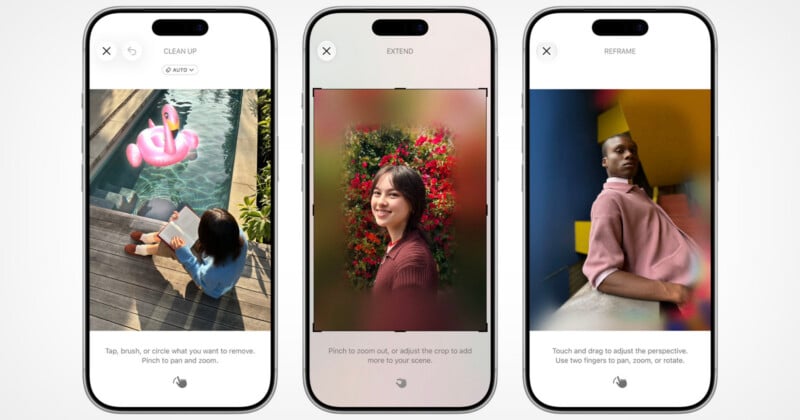
Apple expands AI photo editing and photorealistic image generation with SynthID watermarking
Apple announced new AI image features for Photos and Image Playground, including Spatial Reframing, Extend, improved Clean Up, and photorealistic Image Playground output. Apple says AI-edited photos and generated images will automatically include a hidden SynthID watermark.
Why visual creators should care
For photographers, designers, and agencies, AI editing is moving deeper into everyday photo workflows. Client images may soon include generated infill, reframed perspectives, object removal, or photorealistic synthetic content while still looking like ordinary photographs.
Practical takeaway
Creators should define whether AI photo editing is allowed in a project, whether clients must be told when images are extended or reframed with AI, and whether final delivery should include records of edits, source files, exported versions, and any available watermark or metadata signals.
What to watch next
Watch how durable Apple’s SynthID watermarking is after export, resizing, social upload, third-party editing, and client asset-management workflows.
Sources
Disney v. Midjourney docket keeps AI character-output copyright risk active
The CourtListener docket for Disney Enterprises Inc. v. Midjourney Inc. shows a June 5, 2026 last-known filing in the copyright case against the AI image-generation platform. The case concerns alleged infringement involving AI-generated images and protected entertainment characters.
Why visual creators should care
For illustrators, designers, agencies, and AI image creators, the case reinforces a practical risk: AI-generated visuals that resemble protected characters, franchises, or branded visual worlds can create copyright and licensing problems even when they are generated from prompts.
Practical takeaway
Creators should avoid using AI tools to generate recognizable protected characters or franchise-like campaign assets unless rights are clearly licensed. Client contracts should also state that clients may not request or approve infringing AI-generated variants of protected characters, logos, or branded worlds.
What to watch next
Watch for motions or orders that clarify whether courts treat AI-generated character outputs as direct infringement, derivative works, platform liability, user liability, or a mix of all four.
Sources
Adobe brings Content Credentials details into Experience Manager asset workflows
Adobe updated its Experience Manager Assets documentation for Content Credentials integration. The feature lets users view credential details inside asset records, including whether content was generated or edited with AI, process information, app or device details, and AI tool used.
Why visual creators should care
For agencies, designers, and commercial visual teams, provenance is becoming part of asset management rather than a separate legal note. Clients may increasingly expect asset libraries to show whether images are AI-generated, AI-assisted, edited, credited, or traceable through a workflow.
Practical takeaway
Creators and agencies should decide what provenance information travels with delivered files, whether Content Credentials should remain intact after download or publication, and how much source-file or process information clients are allowed to access.
What to watch next
Watch whether more client asset systems begin treating AI-use records, Content Credentials, and process metadata as standard delivery requirements for commercial visual work.
Sources