Australia says creative work should not enter AI training without creator control
Australian prime minister Anthony Albanese has promised strong copyright protections for writers, artists, musicians and journalists as part of the government’s emerging national AI framework. A government statement said creative workers should retain ownership of their work and that companies should not use Australian creative material to train AI without the artist’s control.
Why visual creators should care
This goes further than a general promise to compensate creators. It places control over training use at the centre of the proposed framework. For photographers, filmmakers, illustrators and visual artists, the difference between compensation after use and permission before use is fundamental.
Practical takeaway
Australian creators should preserve ownership, publication, licensing and delivery records while the policy is converted into legislation. Contracts should identify whether AI training is prohibited, separately licensed or subject to later written approval.
What to watch next
Watch the forthcoming legislative text, the meaning given to creator control, whether collective licensing is introduced, and whether model providers must disclose the works used for training.
Sources
Ireland’s parliament is being asked to put human artists at the centre of AI policy
Sinn Féin’s arts and culture spokesperson Aengus Ó Snodaigh has tabled a Dáil motion calling for a copyright framework that delivers fair remuneration, transparency and accountability when creative work is used by AI. The proposal also calls for public arts funding to support human artists rather than AI-generated content.
Why visual creators should care
The public-funding element broadens the issue beyond copyright infringement. Visual artists may increasingly compete with inexpensive synthetic work for commissions, exhibitions, public campaigns and cultural grants even where no individual infringement can be easily proved.
Practical takeaway
Artists applying for public work should ask commissioners to disclose whether synthetic submissions are permitted and how human creative contribution will be assessed. Professional associations should also press for training transparency and enforceable payment mechanisms rather than voluntary promises.
What to watch next
Watch the wording and result of the Dáil debate, the government’s response, and whether Ireland uses its influence within the European Union to pursue stronger creator safeguards.
Sources
Germany says an AI platform may be responsible for the content it generates
Germany’s Commission for Licensing and Supervision has said that services including Google AI Overviews and Perplexity produce their own media content rather than merely displaying third-party information. The regulator says German media-law obligations can therefore apply, following a Munich court finding concerning allegedly inaccurate material generated by Google.
Why visual creators should care
The principle may matter when AI systems generate captions, summaries, descriptions or contextual claims around photographs and visual reporting. A platform that creates a false account of an image may not be able to rely on the same protections available when it passively hosts material supplied by somebody else.
Practical takeaway
Publishers and visual journalists should record inaccurate AI summaries or captions before requesting correction. Preserve the generated text, linked image, search query, date, territory and screenshots showing how the platform presented the material.
What to watch next
Watch Google’s appeal and whether German regulators apply the same reasoning to generated image descriptions, visual search results and other AI-produced representations of news content.
Sources
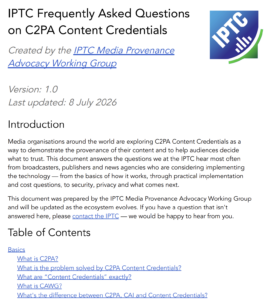
IPTC turns Content Credentials into a more practical newsroom decision
The International Press Telecommunications Council has published a plain-language set of frequently asked questions about C2PA Content Credentials. The resource is aimed at broadcasters, publishers and news agencies considering how to implement provenance technology across photographs, video and other media.
Why visual creators should care
Provenance systems are increasingly discussed as though adding a credential is a single technical step. In practice, publishers must decide how identities are verified, which edits are recorded, how credentials survive production systems and what audiences should infer from their presence or absence.
Practical takeaway
Photographers supplying credentialed files should test whether the client’s ingest, editing, captioning and export systems preserve the credentials. A credential lost during delivery may provide no practical benefit at publication.
What to watch next
Watch adoption by wire services, broadcasters, digital asset-management providers and social platforms, along with clearer rules for displaying credentials to audiences.
Sources
Midjourney wants Hollywood’s internal AI use examined in its copyright defence
Midjourney is challenging a discovery order that limited how extensively it may investigate Disney and Universal’s own use and development of artificial intelligence. The studios accuse the image generator of training on protected material and producing unauthorised versions of well-known characters.
Why visual creators should care
The dispute shows how AI copyright litigation can widen beyond the model provider’s dataset. Defendants may seek internal policies, generated assets, model-development records and licensing practices from the rights holders bringing the claim.
Practical takeaway
Studios and agencies pursuing AI infringement claims should expect their own AI practices to be scrutinised. Maintain consistent rules for internal training, source assets, prompt references, generated concepts and third-party model use.
What to watch next
Watch whether the district judge expands discovery and whether evidence of the studios’ own AI use is considered relevant to infringement, market harm, licensing or available remedies.
Sources
Google lawsuit tests whether limited platform access can become AI-training permission
Hachette, Cengage, Elsevier and author Scott Turow have sued Google, alleging that books supplied for limited services including Google Books, Google Play Books and Google Scholar were later copied to train Gemini without permission. Google had not publicly responded when the initial report was published.
Why visual creators should care
The immediate works are books, but the licensing question is directly relevant to visual archives. Photographs and illustrations are routinely supplied to platforms for search, previews, sales, hosting or distribution. Permission for one of those services does not necessarily include permission to build a commercial generative model.
Practical takeaway
Review agreements with archive, portfolio, marketplace and delivery platforms for language covering machine learning, model improvement, training and derived data. Record the version of the terms that applied when each collection was uploaded.
What to watch next
Watch whether the court treats the original limited-purpose agreements as evidence that AI training required separate permission and whether Google identifies the precise datasets used to train Gemini.
Sources