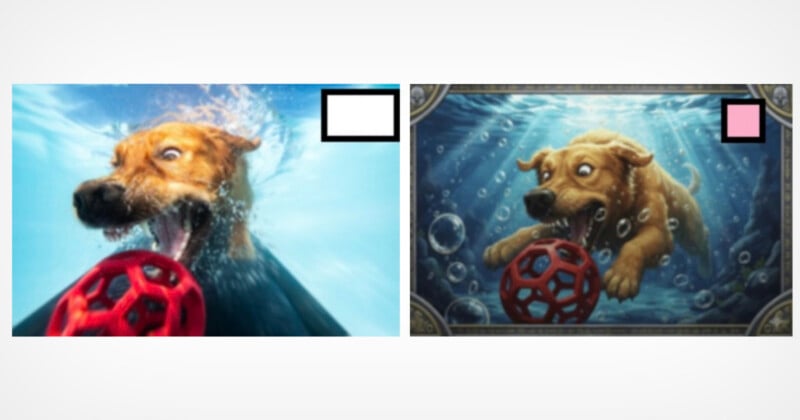
Using a photograph as an AI reference did not automatically make the result an infringement
Germany’s Düsseldorf Higher Regional Court upheld a ruling involving an underwater dog photographer whose photograph was used as input for an AI-generated comic-style image. The court found that the resulting image retained the general motif of a dog reaching for a toy underwater but did not reproduce the photograph’s protected creative choices, including its framing, perspective, lighting and shallow depth of field. The ruling therefore found no copyright infringement.
Why visual creators should care
For photographers, the case draws a difficult distinction between the subject depicted and the creative expression used to photograph it. Copyright can protect the photographer’s specific visual choices without giving the photographer ownership of the general idea or motif. An AI transformation may therefore remain recognisably derived from a photograph while falling outside the photograph’s protected expression.
Practical takeaway
When challenging an AI derivative, identify the specific protected photographic elements that survived into the output rather than relying only on the fact that the original image was used as a reference. Preserve the original, the generated version and any evidence showing that the original photograph was supplied to the AI system.
What to watch next
Watch whether German or EU courts address a closer AI reproduction that retains more of the source photograph’s composition, lighting or perspective, and whether future cases separately examine the legality of supplying the photograph to the generator as an input.
Sources
AP still draws a hard line around generative alteration of news photographs
The Associated Press has updated its newsroom AI standards while retaining its prohibition on using generative AI to create, alter or enhance news photography. AI may assist journalists with tasks such as transcription, translation, research, summaries and shot-list suggestions, but editorial judgment and verification remain human responsibilities. AI-generated or manipulated material included in reporting must be clearly identified and presented in context.
Why visual creators should care
The policy provides one of the clearest professional distinctions between AI surrounding a photographic workflow and AI altering the evidentiary content of the photograph itself. For news organisations, the issue is not whether software contains AI but whether it changes what the audience is being shown as recorded reality.
Practical takeaway
Editorial photographers should retain camera originals and avoid generative removal, replacement, extension or enhancement when working under documentary standards. Newsrooms should record which AI tools were used around the assignment even when none touched the pixels.
What to watch next
Watch whether other agencies and publishers adopt comparable rules and how news organisations treat computational-camera functions that introduce synthetic detail before the photographer begins editing.
Sources
A new draft standard tries to make likeness consent portable
Authentic Interactions has published version 1.0 of its Digital Likeness Directive, a voluntary draft standard intended to let people express whether and how their likeness may be digitally recreated by AI, including after death. The proposal is co-signed by StoryFile, Lookalike.com and Authentex and is open for public comment until September 30.
Why visual creators should care
Likeness consent is currently fragmented across model releases, performer agreements, platform settings and local law. A portable directive could make an individual’s general preferences easier for AI systems and production companies to discover, although it does not replace project-specific consent or statutory rights.
Practical takeaway
Treat a general likeness directive as an additional consent signal, not a substitute for a model or performer agreement. A commercial production should still define the specific person, project, model, duration, territory, generated actions and future reuse rights.
What to watch next
Watch whether major image and video generators recognise the standard, how identity is verified, what happens when a project contract conflicts with the directive and whether the framework gains support beyond its initial private-sector participants.
Sources
Shutterstock is putting licensed stock and generative production inside the same subscription
Shutterstock has expanded its Unlimited Images and Unlimited Plus subscriptions globally. The plans combine large curated collections of licensed stock assets with AI-powered creative capabilities, allowing customers to move between licensed source material and AI-assisted creation within one commercial environment. Shutterstock says Unlimited Images contains more than 83 million images, while Unlimited Plus covers more than 100 million creative assets across image, video, music and sound.
Why visual creators should care
The boundary between acquiring a licensed asset and generating new material from licensed creative content is becoming less visible to the buyer. That makes contributor attribution, source-asset records, model and property releases and the licensing status of transformed outputs increasingly important.
Practical takeaway
Teams using hybrid stock and AI workflows should record the original asset ID, contributor, licence, release restrictions and every generative transformation. Do not assume that an AI-produced derivative inherits every permitted use of the source asset automatically.
What to watch next
Watch how Shutterstock distinguishes licensed downloads from generated derivatives, whether contributors can see when their work enters AI-assisted workflows and how compensation is allocated when licensed content becomes the starting point for a transformed asset.
Sources
Canada is asking how AI-generated material should identify itself
The Canadian government has opened a public consultation on AI transparency running from July 23 to September 23. The consultation specifically asks about detecting and identifying AI-generated content, helping people understand when they are interacting with AI, improving information about AI systems and tracking serious incidents.
Why visual creators should care
Canada has not yet adopted a visual-labelling regime equivalent to the EU’s Article 50 framework. The consultation creates an opportunity for photographers, filmmakers, publishers and provenance organisations to influence whether future Canadian rules rely on visible labels, machine-readable provenance, watermarking, detection or some combination.
Practical takeaway
Canadian creator organisations and businesses should respond with concrete visual-workflow examples. Explain what survives resizing and screenshots, how labels interact with legitimate retouching and what evidence photographers need when authentic work is falsely classified as synthetic.
What to watch next
Watch whether the consultation leads to mandatory AI-output marking, voluntary codes, provenance requirements or platform disclosure rules, and whether Canada aligns technically with the EU or develops a separate standard.
Sources
Adobe’s partner-model retirements show why AI production records need model versions
Adobe’s updated generative-AI model retirement page lists OpenAI Sora 2, Runway Aleph and Runway Gen-3 Alpha Turbo as deprecated from July 23. Adobe says partner models may be removed because of factors including low usage, quality concerns, contract expiry or the provider ending support.
Why visual creators should care
A project may be reproducible today and impossible to reproduce later if the exact model disappears from the software used to create it. For agencies, filmmakers and designers, recording only that an asset was made in an Adobe application is no longer enough when multiple external models can sit behind the same interface.
Practical takeaway
For every AI-assisted deliverable, record the application, provider, exact model name and version, date used and significant settings. Save approved outputs and intermediate assets locally rather than assuming the same model will remain available for later revisions.
What to watch next
Watch how Adobe handles reopening projects that reference deprecated models, whether replacement models reproduce prior results and whether Content Credentials identify the precise partner model used rather than only the host application.
Sources