Google has made AI status a field attached to individual advertising assets
Google’s July 23 Display & Video 360 API update adds an optional syntheticContentAttestationStatus field to Creative and AdAsset resources. Advertisers or their systems can mark a creative or individual image or video asset as IS_SYNTHETIC or NOT_SYNTHETIC. Google says AI labels are then applied when qualifying ads are served in regions with local disclosure requirements, currently including the European Union, India and New York state.
Why visual creators should care
AI disclosure is becoming structured production data rather than a note added after the campaign is built. Asset-level attestation is particularly important because one ad may combine real photography with an AI-generated background or contain several assets produced in different ways.
Practical takeaway
Add an AI-status field to the internal asset record before files enter the ad platform. Record whether each image or video was generated or materially edited with AI rather than trying to reconstruct that history when trafficking begins.
What to watch next
Watch whether agencies integrate the field into DAM and approval systems, how Google treats conflicting declarations and whether asset-level status can travel reliably between campaign platforms and downstream publishers.
Sources
Disney is putting AI video creation inside the same system used to buy the media
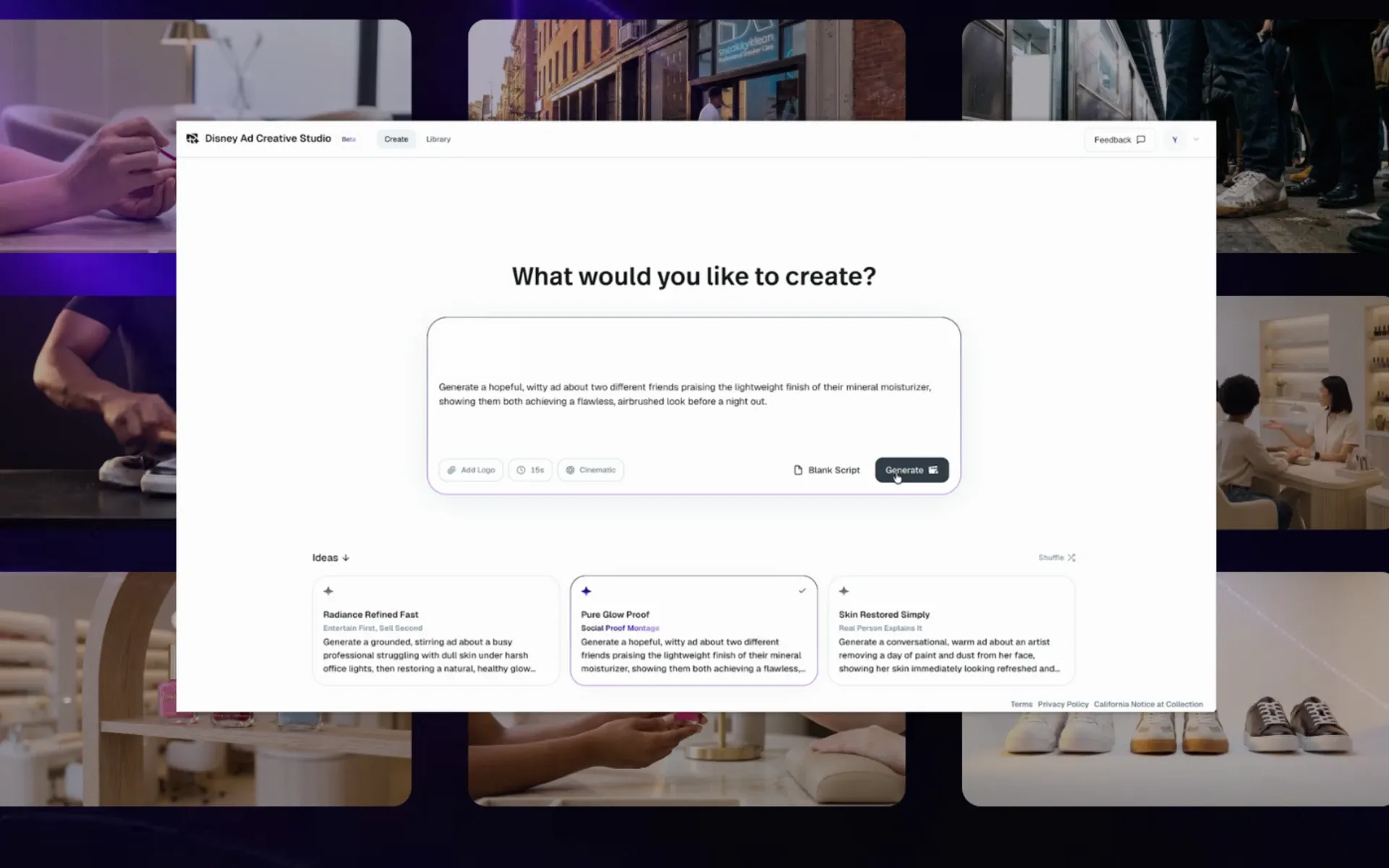
Disney began a closed beta of Disney Ad Creative Studio on July 23. The system sits inside Disney Campaign Manager and combines multiple AI models to turn advertiser-supplied logos, product imagery, brand guidelines and previous creative assets into connected-TV video advertising. Advertisers can create variations for different audiences and markets, route work through approvals and prepare the resulting campaign for activation within the same workflow.
Why visual creators should care
For commercial photographers, filmmakers and agencies, generation is moving directly into the media-buying stack. A client can potentially supply an existing product photograph or campaign asset and produce multiple video executions without commissioning a conventional production for every version.
Practical takeaway
Commercial agreements should specify whether supplied photographs, footage and design assets may be used as inputs for generative advertising. Define whether the client can create new scenes, animations and derivatives from delivered material and whether those rights continue after the original campaign.
What to watch next
Disney has not disclosed the underlying models, general availability date or how advertiser source assets are retained after campaigns. Watch particularly for AI disclosure, provenance and rules governing image, voice and likeness inside generated advertising.
Sources
Higgsfield is rewriting the contract around uploaded creative work
Higgsfield says its July terms update clarifies that creators own their inputs and outputs and may use outputs commercially. Changes already in effect include C2PA provenance metadata on video outputs, a 30-day deletion window and restrictions covering non-consensual intimate imagery and biometric use. The company says revised terms taking effect for existing users on August 7 will narrow its licence to user content, make clear that private content remains private and introduce a model-training opt-out.
Why visual creators should care
AI-tool terms are part of the rights chain for professional production. Photographers and agencies may upload client photographs, unreleased campaign assets, faces and copyrighted references to a generator. Ownership of the final output is only one question; the service’s rights over the inputs and whether they may be used for training can matter just as much.
Practical takeaway
Archive the terms that applied when a project was produced. For confidential work, check separately who owns the output, what licence the service receives over source material, whether training can be disabled and how deletion affects previously uploaded files.
What to watch next
Higgsfield says the complete revised wording will be published before August 7. Review the actual legal text when available rather than relying solely on the company’s explanatory article, particularly for training, deletion and private-content provisions.
Sources
Facebook is introducing a badge whose main claim is simply that the person is real
Meta has announced Facebook Verified, a free badge for eligible adult users who complete a short video-selfie check against their existing profile photographs. Meta explicitly frames the system as a response to AI making it easier to generate content, profiles and messages. The badge will initially appear on profiles and in Marketplace, Dating and Groups, with Feed posts planned later.
Why visual creators should care
Platforms have spent years labelling synthetic content. Facebook is now approaching the same trust problem from the opposite direction by attaching a visible signal to a verified human identity. For photographers, models and other public-facing creators, this points towards an environment in which proving that a person is real may become as important as labelling content that is synthetic.
Practical takeaway
Treat identity verification and likeness permission as separate things. A verified badge can establish that an account corresponds to a real person; it does not establish that an image of that person, or a synthetic replica derived from them, was authorised.
What to watch next
Watch how widely the badge is adopted, whether creator and professional accounts become eligible and whether Meta begins using verified-human status alongside its AI-generated-content labels and likeness-protection systems.
Sources
X is using AI to decide who should receive the money when creator content is copied
X says a newer version of Grok can detect duplicated content at roughly three times the rate of its previous system. According to the platform, adding watermarks, intros or other superficial modifications intended to disguise copied material will not necessarily prevent detection, and monetised impressions can instead be attributed to the original uploader. X said it identified 1.5 million stolen posts in its latest cycle and was redirecting more than $1 million in creator payouts.
Why visual creators should care
Original visual content is routinely downloaded, cropped, watermarked, repackaged and reposted. If platforms begin using similarity systems to determine who receives creator revenue, questions of originality, first upload and legitimate reuse become financial rather than merely reputational.
Practical takeaway
Creators publishing original photographs or video should keep dated masters and publication records. A platform’s first-upload record may help with monetisation, but it is not a substitute for copyright ownership evidence or a licence showing that another account had permission to repost the work.
What to watch next
Watch how X handles photographers who publish through multiple accounts, agencies posting on behalf of clients, licensed syndication and legitimate transformative uses that resemble copied material.
Sources
Content Credentials can disappear before the audience ever sees the image
Researchers building a dataset of 10,217 confirmed GPT-image-2 pictures posted publicly on X found that C2PA Content Credentials were systematically stripped by the platform’s content-delivery process. The images could still be identified through other signals used during the research, including X’s own Made with AI presentation, but cryptographic verification from the downloaded social-media image was no longer possible.
Why visual creators should care
A generator can attach a valid provenance record and the creator can deliver the correct file, yet the audience may receive a platform-processed copy with that record removed. That is a critical distinction as regulators and commercial clients increasingly expect machine-readable AI disclosure.
Practical takeaway
Test provenance after publication, not just before upload. Preserve the original credentialed file and a verification record separately, and do not promise a client that Content Credentials will remain available on every downstream platform unless that delivery path has been tested.
What to watch next
Watch whether X begins preserving C2PA manifests or exposes provenance through another durable mechanism, and whether regulators treat a provider’s original marking as sufficient when an intermediary later removes it.
Sources