Google has put a generative image editor directly inside the everyday office workflow
Google launched Google Pics on September 1, rolling the AI image creation and editing product out to Google AI Pro and Ultra subscribers and most Workspace business customers. Built on Google’s Nano Banana image model, Pics can generate images, isolate and alter individual objects, edit or translate text inside images, make multiple targeted edits and allow teams to collaborate on the same visual. Integration begins in Docs and Slides, with Drive support following.
Why visual creators should care
AI image generation is moving out of specialist creative applications and into the software where clients, account teams and agencies already prepare presentations and documents. That means people who are not image specialists can now materially modify supplied photography without ever opening Photoshop.
Practical takeaway
For client photography and design work delivered into collaborative Workspace environments, define whether downstream generative editing is allowed. If visual accuracy or authorship matters, keep the approved master separately from later Workspace derivatives.
What to watch next
Watch how Google exposes provenance for Pics creations and edits, and whether Workspace administrators receive controls over generative modification of existing visual assets.
Sources
Photoroom is putting the accuracy of an AI product photograph into the contract
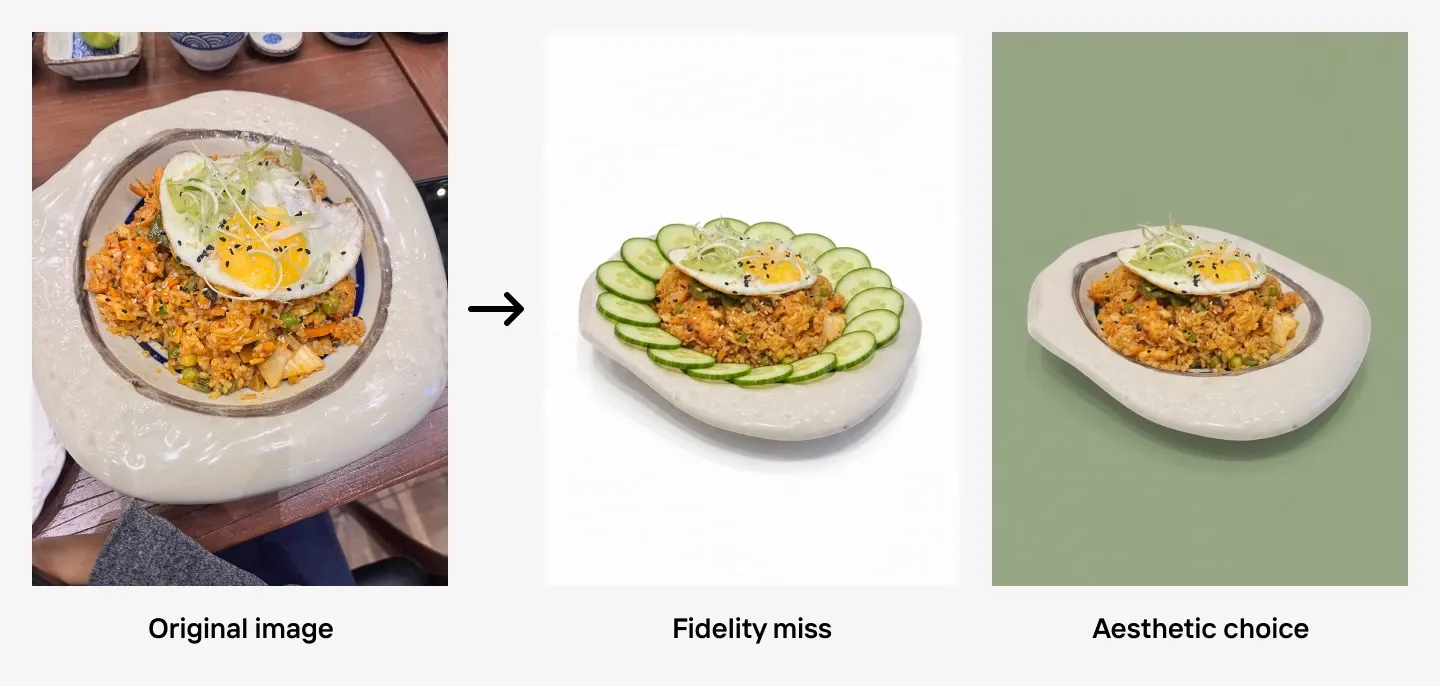
Photoroom’s September 1 Enterprise Guarantee allows qualifying food and fashion customers to agree factual product-fidelity criteria before production. Every generated image is checked against those criteria and failed outputs are regenerated or fixed without charging the customer for the failed attempt. Covered failures can include incorrect product colours, missing or added ingredients, distorted shapes and other factual changes to what is being sold; subjective choices such as background colour or lighting direction sit outside the guarantee unless otherwise agreed.
Why visual creators should care
Product photography has a different risk from many forms of creative generation: an attractive image can still be commercially wrong. A generated garment in the wrong colour or food photograph containing an ingredient the product does not contain can misrepresent the item being sold.
Practical takeaway
For AI product imagery, define factual fidelity in writing before production. Keep the original product photograph and agreed criteria with the approved generated image so there is a record of what the AI was permitted to change.
What to watch next
Watch whether agencies and marketplaces begin requiring contractual visual-accuracy thresholds rather than relying on ordinary subjective creative approval.
Sources
SCAYLE’s new image terms promise no training on client product photography without written permission
SCAYLE Studios’ European terms for its TAYLA AI image and video system became effective September 1. They say customer product photographs and prompts will not be used to train TAYLA or other AI or language models unless the customer gives written authorization. Generated output also carries C2PA-based provenance. The rights position is more complicated on the result itself: SCAYLE retains or receives extensive intellectual-property rights over generated output while granting customers perpetual commercial usage rights, with some output marked as exclusive receiving an exclusive usage licence.
Why visual creators should care
A no-training promise does not necessarily mean the customer owns all rights in what the system produces. This is a good example of why input protection, output copyright and commercial usage permission need to be recorded separately.
Practical takeaway
For agency work, do not reduce the contract to 'our images are not used for training'. Record separately what happens to source photography, who owns or controls the generated result, whether the output is exclusive and what provenance is attached.
What to watch next
Watch whether enterprise visual platforms increasingly offer explicit exclusive-output options and whether clients begin requiring those rights distinctions at procurement stage.
Sources
AI can now write directly into the metadata record attached to an agency’s image library
Adobe updated its Experience Manager documentation on September 1 for Brand Aware Metadata, a beta system that automatically generates metadata for images. Teams can define prompts to create alt text, product attributes, asset classifications, region and language information as files are uploaded or reprocessed. Adobe allows controlled vocabularies and preview testing, but warns that generated values overwrite existing metadata and that its general-purpose GPT model may be unreliable for specialised identification such as exact product SKUs.
Why visual creators should care
Metadata is not merely descriptive decoration. In professional asset libraries it can drive search, publishing, accessibility and downstream workflow decisions. An incorrect AI-generated description or classification can therefore propagate much farther than a bad caption typed into one page.
Practical takeaway
Do not allow generated metadata to overwrite authoritative photographer, rights or product information without review. Separate machine-generated descriptive fields from provenance, copyright, credit and licensing metadata wherever possible.
What to watch next
Watch whether DAM platforms begin marking which metadata fields were machine-generated and whether human corrections are preserved rather than overwritten when assets are reprocessed.
Sources
Submitting an artwork can now include permission for users to make AI derivatives from it
Cuto’s revised Wallpaper Submission License Agreement became effective September 1. It expressly allows the platform, where a product offers the feature, to let end users initiate AI-based animation, outpainting, repainting, stylisation and other transformations of a submitted work. The licence also addresses boundaries around model training. Artists can withdraw work, but licences required for derivative content created before withdrawal and existing user rights can continue afterwards.
Why visual creators should care
For illustrators and photographers licensing work to visual platforms, 'display my image' and 'let users generate new work from my image' are fundamentally different permissions. New creator agreements are increasingly bundling both possibilities into the same submission contract.
Practical takeaway
When supplying artwork to a platform, search the licence for derivative and generative-AI clauses rather than checking only whether you retain copyright. Also check what survives if you later withdraw the work.
What to watch next
Watch whether visual marketplaces begin offering creators separate opt-ins for display, conventional derivatives and generative-AI transformations instead of combining them in a single licence.
Sources
Turning a photograph into a 3D asset can also send it into somebody else’s AI infrastructure
OneClick3D’s Terms of Service were updated September 1 for its image-to-3D generation service. Users retain ownership of uploaded photographs and own the generated 3D models, which can be used commercially. The service itself relies on third-party AI provider fal.ai to process the source images. Users must have the rights to upload those photographs and remain responsible for third-party rights associated with the resulting models.
Why visual creators should care
For photographers and designers, image-to-3D conversion is another form of downstream reuse that may not have been contemplated when a photograph was originally commissioned. The fact that the creator owns the generated model does not answer whether the source photograph could be sent to an external AI provider in the first place.
Practical takeaway
Before converting client photography into 3D assets, check both the original photography licence and the AI service’s processing chain. Record that a third-party provider received the source file where confidentiality or restricted usage matters.
What to watch next
Watch whether image-to-3D providers begin offering enterprise no-training and confidentiality guarantees comparable with those appearing in image and video generators.
Sources