A museum has documented exactly what happens when its collection becomes AI source material
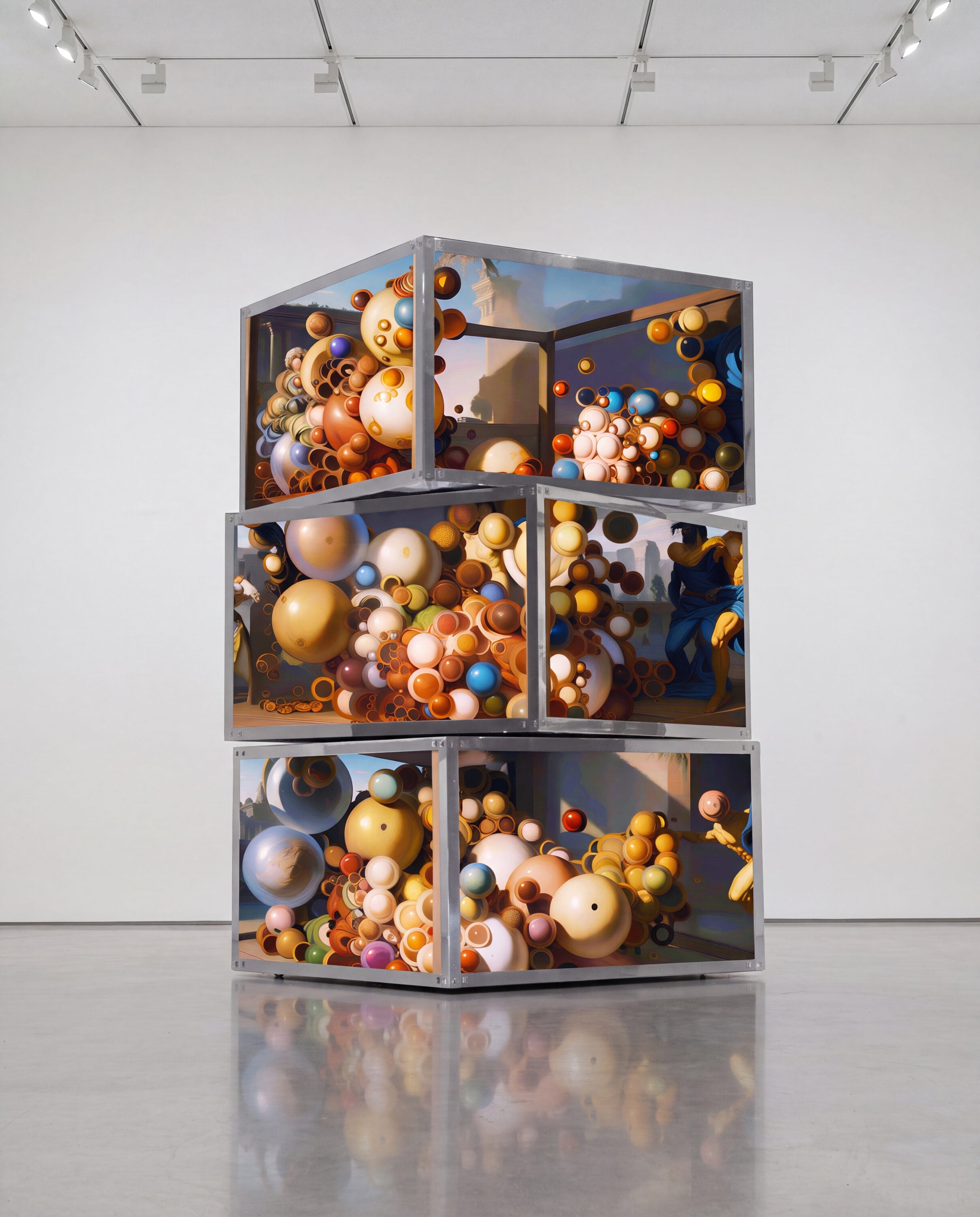
The Madison Museum of Contemporary Art opened Beeple's Diffuse Control on September 19. The interactive installation uses Stable Diffusion, custom software, audience input and selected images from MMoCA's permanent collection to generate continually changing imagery across twelve screens. More important for visual-rights practice, the museum has published its source-image policy. Collection works are either public domain or used with permission from the relevant copyright holder. The selected files remain inside Diffuse Control's local closed system rather than being uploaded into a public training dataset, and identifying information for the source artworks is preserved as part of the installation's documentation.
Why visual creators should care
This is a rare practical example of an institution separating permission to transform an artwork with AI from permission to use that artwork for model training. It also keeps attribution attached to the source as the generative work changes.
Practical takeaway
For client or cultural-heritage projects, record three things separately: permission to access the source image, permission to create the AI derivative, and permission, if any, to contribute the source to model training. They are not the same use.
What to watch next
Watch whether museums and agencies begin adopting similarly explicit local-processing requirements for valuable or rights-restricted visual archives.
Sources
A real photograph can now need evidence to prove that it is real
Photo-verification service Lumethic updated its analysis of AI-detector false positives on September 19. It documents how genuine photographs can trigger synthetic-image classifiers after ordinary professional processing including AI denoising, skin retouching, strong colour grading, upscaling and social-media recompression. Its central distinction is that AI detectors classify statistical characteristics of pixels; they do not verify where an image came from. The service argues that retaining the original RAW and linking the finished JPEG back to that camera file provides a stronger authenticity record.
Why visual creators should care
The authenticity problem has flipped for photographers. It is no longer only necessary to identify synthetic images; genuine photographers may increasingly be asked to demonstrate that their work originated in a camera.
Practical takeaway
Keep the RAW. For important editorial, competition, documentary and commercial images, also retain intermediate edits and export history. Treat an AI-detector score as a signal rather than proof of either generation or authenticity.
What to watch next
Watch stock libraries and photography competitions for formal appeal procedures when automated AI detectors flag genuine submissions, and for wider adoption of RAW-linked C2PA verification.
Sources
Jordan Wolfson is using AI to alter what happened inside an existing photograph
Jordan Wolfson's first New York solo exhibition with Gagosian opened September 18. The new sculptures incorporate photographic imagery drawn from online, personal and academic archives. In first-party discussion of the exhibition, Wolfson describes one AI transformation beginning with an existing photograph of Allen Ginsberg. The original image was supplied to the AI system and altered so surrounding people's eyes appeared to look toward Ginsberg; generated text also appeared where a newspaper existed in the source.
Why visual creators should care
The work illustrates a category increasingly important to photographers: the image is neither a conventional untouched photograph nor a wholly generated scene. A historical source photograph remains structurally present while AI changes what appears to have happened inside it.
Practical takeaway
When AI alters documentary or archival imagery, preserve the source and record the substantive changes. 'AI-assisted' alone does not tell a later viewer whether gaze, expression, text, people or events were reconstructed.
What to watch next
Watch galleries, museums and publishers for more specific labelling of image-to-image transformations where an existing documentary or archival photograph remains recognisable in the final work.
Sources
Rankin has spent thousands of hours generating images and says it pushed him back toward photography
British photographer Rankin's current Paris exhibition LA F.AI.M presents work from several years of intensive generative-AI experimentation. A. Galerie says Rankin has produced thousands of generated images spanning portraiture, fashion, mythology, art history and photographic language. The exhibition deliberately treats AI as a way of interrogating authorship and authenticity rather than simply as a replacement image-making technology. Rankin says the experience ultimately increased his attachment to photography because the generator lacks the curiosity, memory, doubt and desire that motivate his own practice.
Why visual creators should care
A professional photographer with a long commercial and editorial career is treating generative imagery as a separate but adjacent visual practice. That makes the distinction between photographic authorship, generated output and human selection more useful than collapsing all three into 'AI photography'.
Practical takeaway
When presenting generative work alongside photography, describe the process accurately. If there was no camera capture, calling the work photographic because it resembles a photograph can obscure rather than explain its origin.
What to watch next
Watch whether galleries and publishers settle on clearer terminology for work made by established photographers using generators but without photographic capture.
Sources
One artist is putting the camera's forensic fingerprint beside the AI transformation
Mark Dorf's Origin of a Made Place, whose run ended September 19 at RYAN LEE Gallery, begins with photographs of roses captured at Portland International Rose Test Garden. Dorf processes the images through what the gallery calls inverse diffusion, moving between the photograph and the noise from which a generative system might construct an image. Alongside the moving imagery, the installation displays a Photo Response Non-Uniformity variance map: the sensor-level pattern associated with the particular camera used to make the source photographs.
Why visual creators should care
The work makes an increasingly important distinction visible. The appearance of an image can be transformed almost without limit, while evidence tied to the physical capture device can provide a different kind of information about where the source originated.
Practical takeaway
For high-value or authenticity-sensitive photography, preserve camera originals rather than relying only on exported JPEG metadata. Capture evidence and visual appearance are becoming separate layers of the image record.
What to watch next
Watch for sensor-origin verification, signed capture and C2PA records to move from specialist forensic practice into ordinary professional photography workflows.
Sources
Permission to use an AI prompt is not permission to use every image it produces
Picture Prompts' terms became effective September 19. The site provides curated prompts designed for image generators including Gemini, Midjourney, DALL-E 3 and Stable Diffusion and expressly permits users to copy those prompts for personal and commercial image generation. The terms nevertheless leave the resulting generation subject to the rules of the external service used to create it.
Why visual creators should care
Prompt libraries add another rights layer to multi-model image production. Permission to use the words that initiate a generation does not determine whether the resulting image can be commercialised, whether a model provider claims particular rights or whether reference material inside the generation was authorised.
Practical takeaway
For commercial AI imagery, record the prompt source and the generator separately. A commercial-use prompt licence cannot override the image model's terms or clear third-party copyright, trademark or likeness rights in the resulting visual.
What to watch next
Watch whether professional prompt marketplaces begin supplying licence records that can travel with generated assets and identify the model and terms under which the final image was produced.
Sources