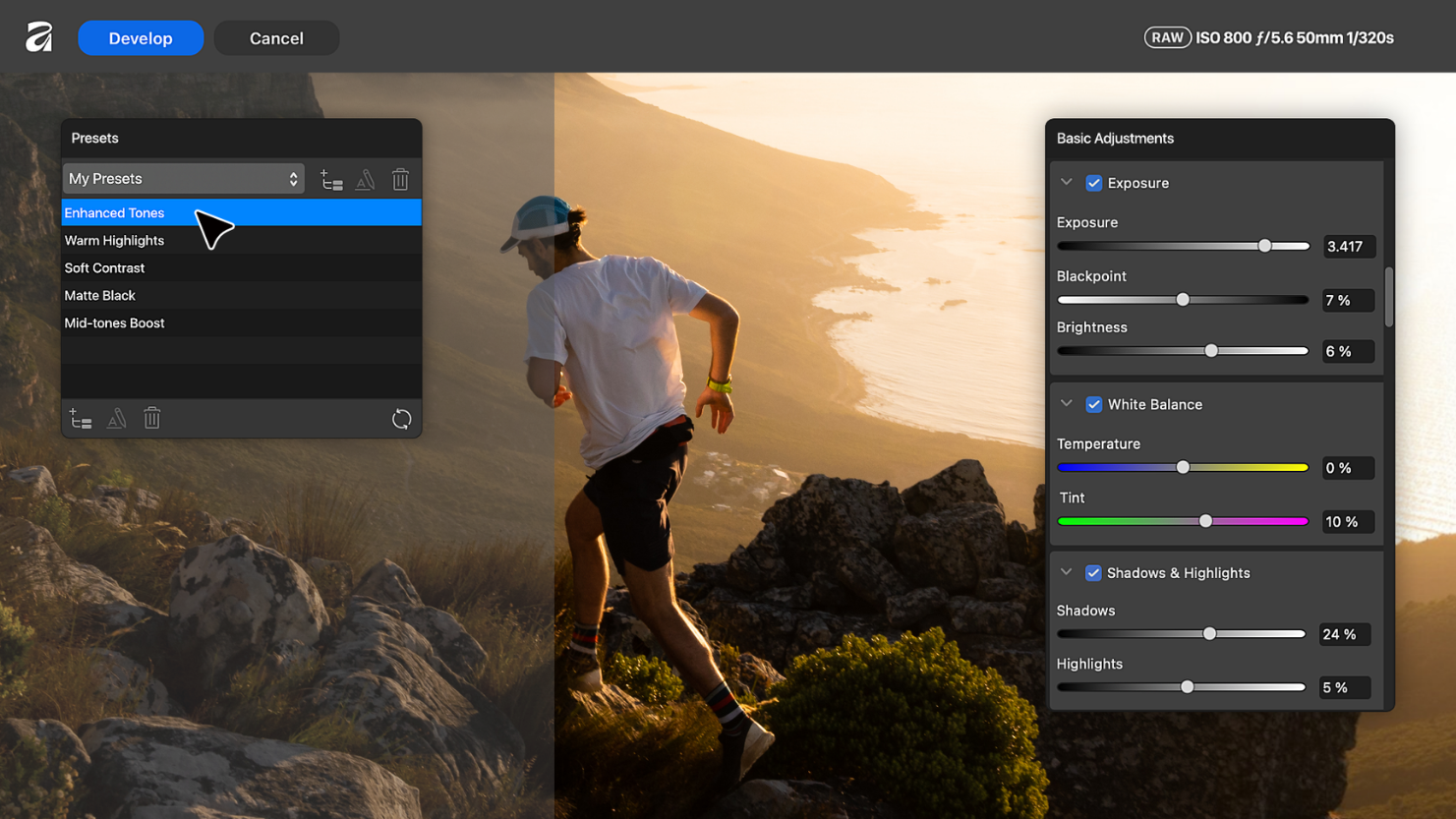
Affinity is putting generative tools beside the RAW file without taking the RAW file away
Canva launched its ProSuite on September 22 with what it describes as Affinity's biggest photography update yet. The release includes an improved RAW engine, batch import, reusable looks, mixed-light and camera-shake correction, AI-assisted Scene Decomposition, Motion Blur Reduction, Generative Upscale, Image to 3D and SDR-to-HDR tools. Scene Decomposition can take a flattened image and reconstruct it into editable layers. The important rights and privacy detail is explicit: Canva says work inside Affinity is not used to train these AI features and Affinity cannot access the user's files because they remain stored locally on the device.
Why visual creators should care
Professional photographers have increasingly had to choose between powerful AI editing and sending source photographs into a remote processing or training system. Affinity is making local file handling and no-training treatment part of the product proposition.
Practical takeaway
When comparing AI photo editors, add processing location and training use to the feature comparison. A tool that performs the required operation while keeping client files local can materially reduce confidentiality and rights-management problems.
What to watch next
Watch whether Adobe, Capture One and other professional imaging platforms respond by making local processing and no-training guarantees more visible at feature level rather than only in general privacy documentation.
Sources
Evoto is moving AI portrait retouching from individual photographs into the video timeline
Evoto 8.0 launched September 22 with portrait retouching running directly inside DaVinci Resolve, allowing facial and skin adjustments to track subjects through moving footage. The release also introduces Story-Based Culling, reusable production workflows, an enterprise SDK, Generative Expand and a new Asset Hub. The marketplace allows photographers to sell presets, AI Looks, backdrops and skies. Evoto says creators retain ownership, can sell the same assets elsewhere and receive 60 percent of net sales. Submitted creator assets must be original work the creator legally owns and must not infringe third-party rights.
Why visual creators should care
AI-assisted portrait manipulation is no longer confined to a single retouched still. The same type of intervention can now follow a person's face through hundreds of frames, making client permission and the distinction between correction and substantive alteration increasingly relevant to hybrid photo/video assignments.
Practical takeaway
For assignments covering both stills and motion, make sure model and client agreements do not silently assume that retouching permission for a photograph automatically covers tracked AI manipulation throughout video footage.
What to watch next
Watch how studios describe AI video retouching in client approvals and whether Evoto's new marketplace develops clear rules around presets or AI Looks derived from previous commissioned work.
Sources
The software underneath Content Credentials has just needed a critical security patch
Adobe published security bulletin APSB26-147 on September 22 for its Content Credentials SDK. The company says vulnerabilities in the Content Credentials Rust SDK and C2PA Tool could cause security-feature bypass and application denial-of-service. Two issues are rated critical. Adobe says it is not aware of exploitation in the wild and recommends updating to c2pa-v0.90.17 and c2patool-v0.27.17.
Why visual creators should care
C2PA is increasingly being treated as infrastructure for establishing where images came from and what happened to them. That makes the integrity of the software creating and validating those records part of the provenance problem itself.
Practical takeaway
Studios, publishers and developers running their own C2PA tooling should update rather than assuming a signed provenance workflow remains trustworthy simply because it uses the standard.
What to watch next
Watch whether downstream applications embedding older versions of the SDK issue their own updates and how quickly production provenance systems adopt the patched libraries.
Sources
Australia's AI copyright argument is moving from a broad exception to conditional permission
OpenAI and Anthropic have urged Australia to reconsider its refusal to permit copyrighted Australian creative content to be used for AI training. Reuters reports that both companies accept that a broad copyright exception has little political support. Anthropic instead proposed a narrower conditional approval mechanism, potentially linked to investment or support for Australian creators, while OpenAI argued for a framework allowing models to learn from publicly available information while providing opportunities for rightsholder collaboration. Australia's Joint Select Committee on Artificial Intelligence is due to report in November.
Why visual creators should care
For photographers, illustrators and visual artists, this is the central training-rights question in unusually clear form: does public availability create a route into commercial AI training, or should training remain a separately authorised use of the copyrighted work?
Practical takeaway
Keep publication permission and AI-training permission distinct in contracts and rights records. A photograph being publicly accessible does not itself tell a client, platform or model developer what AI-training permission the creator intended.
What to watch next
Watch the Australian parliamentary report in November and whether any conditional model includes creator payment, opt-out, collective licensing or evidence requirements for training datasets.
Sources
AI imagery is moving from a screen output into a production file for physical products
xTool announced a major upgrade to its Atomm platform on September 22. Atomm combines prompt-based image generation and editing with background removal, segmentation, vectorisation, layer separation and conversion of photographs into 3D models for engraving. The system is designed to take an idea through to files ready for laser cutting, printing and other physical fabrication. xTool also announced a $1 million creator programme covering content creators, third-party generator developers and video creators.
Why visual creators should care
When generated imagery becomes a physical product, rights mistakes become harder to dismiss as experimental output. A generated illustration, transformed photograph or reference-derived design can move directly into merchandise, engraving or manufactured objects.
Practical takeaway
Before an AI-derived design becomes a production file, check the rights in uploaded reference imagery, recognisable people, logos and third-party artwork. Treat fabrication as publication or commercial exploitation, not merely another generation step.
What to watch next
Watch the marketplace and developer terms around creator assets and third-party generators, particularly how responsibility is allocated when generated material becomes a product for sale.
Sources
A platform AI label can come from provenance data rather than an AI detector
A September 22 practical test published by explainx.ai reports uploading an AI-generated image carrying C2PA Content Credentials to LinkedIn and X. Both services displayed AI-related provenance information: LinkedIn surfaced a Content Credentials panel while X displayed a Made with AI label. The reported test is significant because the platforms were reading embedded provenance information rather than attempting to infer generation from the appearance of the pixels.
Why visual creators should care
This is the distinction photographers need when discussing AI detection. A classifier makes a probability judgment about an image; provenance metadata carries information supplied and cryptographically bound earlier in the production chain. They are different mechanisms and can produce very different evidence.
Practical takeaway
Where origin matters, preserve embedded Content Credentials through export and test what happens when the file enters the actual publishing platform. Do not treat a platform's AI label as proof that it used pixel-based detection.
What to watch next
Watch how consistently social platforms preserve and expose C2PA information after resizing, recompression, screenshotting and reposting.
Sources