AI advertising can remove the creator while keeping almost everything else they made
Creators Elliot Choy and Pushpek Sidhu say videos they made were repurposed in advertising for prediction-market company Kalshi without permission or payment, with AI used to replace them with white men. Choy's original apartment video and the resulting advertisement reportedly retained recognisable elements including the setting, computer and books. Sidhu says another advertisement closely reproduced his World Cup predictions video after an earlier collaboration discussion with Kalshi went nowhere.
Kalshi told reporters the advertisements were several months old, had been produced by an outside agency, and that the company no longer uses AI-generated content depicting people. It says it is reviewing its relationship with the agency.
Why visual creators should care
Replacing the visible creator does not necessarily remove the rights history of the underlying footage. The framing, performance, script, location, edit and original video can remain recognisably derived from somebody else's work even after AI generates a different person on screen.
Practical takeaway
Brands and agencies should licence the underlying creator footage before using it as the basis of video-to-video generation. For creators, keep original project files and publication dates because the evidence may matter even if AI removes your face from the derivative advertisement.
What to watch next
Watch whether either creator pursues formal copyright, publicity or contractual claims and whether advertising agencies begin adding explicit video-to-video and synthetic-performer permissions to creator licences.
Sources
Reve has stopped generating, but the more important deadline is the archive
Reve's deadline for creating new images and videos passed on September 27. Its official help documentation says existing users can continue downloading generated images and videos until October 31. The bulk-download system can package creations from the web and mobile apps, but Reve explicitly says uploaded images and reference files are not included in those exports.
Why visual creators should care
A visual creator's working project is often larger than the generated output. Reference photographs, source imagery and other inputs can be essential to reconstructing the creative and rights history, yet they may never leave with a platform export.
Practical takeaway
Archive AI projects while the service is still operating. Save outputs, source photographs, references, prompts, model information and important settings independently rather than assuming the platform's export contains the complete project.
What to watch next
The hard date is October 31, when Reve says access to existing generated assets ends. Watch how former users migrate reference-led workflows to other image-generation platforms.
Sources
C2PA metadata and an invisible watermark can tell two different parts of an AI image's history
A September 27 hands-on test by Pixvisor downloaded newly generated images from ChatGPT and Gemini and inspected the resulting files. Both carried signed C2PA manifests identifying generative processing. The test found that ordinary copying, screenshots and re-uploading could remove the file-level manifest. The manifests also declared invisible pixel-level watermarking, including SynthID on the Gemini image, which is a separate provenance mechanism and is not removed simply by deleting metadata.
Why visual creators should care
Creators increasingly hear 'Content Credentials', 'watermark' and 'AI detection' used as though they are interchangeable. They are not. A C2PA manifest travels with the file structure; an invisible watermark is embedded differently; a detector makes an inference. Losing one does not necessarily mean every provenance signal has disappeared.
Practical takeaway
Where provenance matters, preserve the original downloaded or exported file and test what survives the real publication path. An empty metadata inspection after social-media processing does not by itself establish that the image lacked provenance at creation.
What to watch next
Watch whether social platforms preserve C2PA manifests more consistently and whether provider watermark-verification tools become accessible enough for publishers and clients to use routinely.
Sources
AI enhancement can turn a real news photograph into something that looks like different evidence
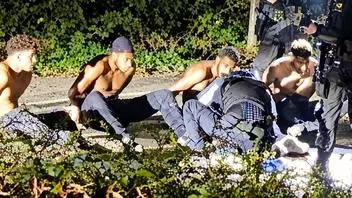
Lead Stories investigated a sharp image circulating on September 27 that purported to show five people arrested near RAF Fairford in the UK. The fact-check found that it was not an original sharp news photograph but appeared to be an AI-enhanced reconstruction based on a blurry photograph of the arrests already circulating online. The investigation reports that a provenance/detection check identified an AI signal associated with the manipulated image.
Why visual creators should care
Generative enhancement is particularly sensitive in documentary and news photography because invented detail can be mistaken for captured detail. A reconstructed face, garment or object may look photographic while no camera ever recorded those pixels.
Practical takeaway
Do not use generative enhancement to recover evidential detail without clearly labelling the result as a reconstruction. Keep the camera original available alongside any enhanced version.
What to watch next
Watch whether newsrooms adopt explicit labels distinguishing conventional sharpening and denoising from generative reconstruction, especially for low-resolution breaking-news images.
Sources
A human-only art marketplace is asking creators for process evidence instead of trusting an AI detector
Mosaic Commissions updated its Community Standards on September 27 ahead of their general October 1 effective date. The marketplace prohibits AI-generated and AI-assisted work in final deliverables. If a work is challenged, sellers can provide works in progress, layered files or timelapses. Mosaic explicitly says an AI-detector result is not sufficient on its own because such tools can falsely classify human work. The policy also prohibits artwork purchased through Mosaic from being used to train AI or machine-learning models at any licence tier.
Why visual creators should care
The policy treats human authorship as something demonstrated through a production history rather than something an algorithm can reliably infer from finished pixels.
Practical takeaway
Even creators who never use generative AI have a reason to retain layered files, sketches and intermediate versions. In a market where human authorship itself can become disputed, ordinary process files can become evidence.
What to watch next
Watch how Mosaic handles its first disputed cases and whether other human-only marketplaces adopt process-based review instead of automated AI-detection thresholds.
Sources
A film festival is separating human cinema and generated cinema before comparing what audiences experience
Sparknify announced the winners of its 2026 Human vs. AI Film Festival on September 27 after receiving more than 3,000 submissions. Thirty-two shorts were selected: 16 human-produced films and 16 AI-generated films. The two groups were evaluated through separate specialist juries before category winners advanced further. Alexandra Lukina's Down The Hatch received the Humanity Award, Gabriel Mellin's The Way You Sea Me received Best Cinema, and BENCH by Mooshin Rhee and STUDIO aim was named Best AI-Generated Film.
Why visual creators should care
The classification approach is more informative than putting every film into a single undefined 'AI-assisted' category. It allows audiences and filmmakers to know which production route they are actually comparing.
Practical takeaway
Festivals accepting both conventional and generative filmmaking should define categories around production method and require enough disclosure for entrants to demonstrate where a film belongs.
What to watch next
Watch whether larger film festivals adopt similarly explicit production categories or instead develop thresholds for hybrid films containing both photographed footage and generated sequences.
Sources